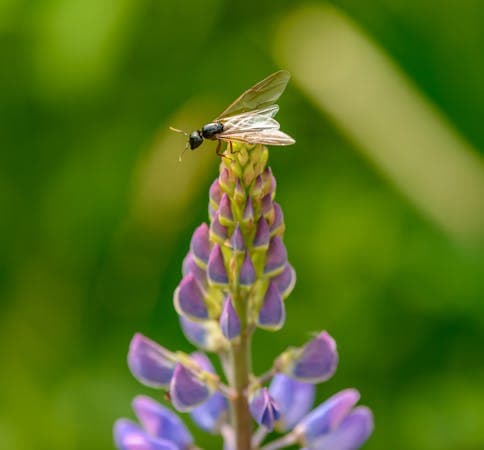
How to Identify Flying Ants vs. Flying Termites
It could be a flying ant or it could be a flying termite. Either way, it's definitely a home-invading pest! Flying insects of any kind in your home is never a good thing.
Both termites and ants are common household pests, and because they are so small, at first glance it may hard to tell which is which. But there are key differences in appearance and behavior that can help you know exactly which insect you are dealing with.
An infestation of either flying ants or flying termites can be problematic, but it is important to be able to identify them so you know which course of action to take to solve the problem.
How To Identify Flying Ants
Flying ants are really just ants in general, but in particular those that are getting ready to breed. During the summer, a flying ant might simply make its way inside your home by accident through a crack in the wall or an open door.
However, if you spot a flying ant in the winter this can be more problematic. Ants don't typically breed during this time of the year, so if you see one in your house it is more likely that there is a nest somewhere in your home. Carpenter ants in particular tend to nest in wooden structures.
Carpenter ants are one of the most common types of flying ants found inside homes, and they are often confused with termites. They are one of the largest of all ant species. You can identify them by their dark-colored bodies, narrow waists, bent antennae, and hind wings that are shorter than their front wings.
How to Identify Termites
Both species can have wings. All this means is that the insect is a reproductive male or queen which are the only members of their colonies that can reproduce. Also, both species swarm to mate, and drop their wings after doing so.
The way to tell them apart is in the unique characteristics in the wings. For example, termites will have four equally shaped and sized wings, while the wings on an ant will be smaller, and of two different sizes.
Termite wings are disproportionately large, and can often be spotted before you even see the bug itself. They have straight antennae, and broad, uniform body shapes.
Which Infestation Is Worse?
Ideally, you don't want any pests invading your home. However, a carpenter ant infestation is definitely the more desirable of the two. Carpenter ants are much less destructive to homes than termites, although they too can inflict some serious damage.
Termites eat the wood in which they tunnel while carpenter ants only nest in it. This means termites have the ability to cause a lot more serious structural damage.
Both species can cause structural damage so it's important to get rid of an infestation no matter what kind you think it may be. Also, both species can live for many years with worker ants and queen termites living for decades.
How Do I Get Rid of an Ant or Termite Infestation?
As both species nest in wood, particularly wood that is wet or decomposing, it is best to repair or replace the rotted wood to remove the current infestation. It is a good idea to do this even if it hasn't been infested yet as this will help to prevent a future infestation.
From there you have several options to control the infestation. You can use insecticidal dust which is approved for indoor household use. Simply inject it into the places where they are nesting. However, you may need to drill small holes to target specific areas of the wood.
Baits are also common, but tend to be more effective for ants. Foraging ants will pick up the bait, and bring it back to the colony wiping out the whole population.
Preventing and Controlling an Infestation
The best way to control an infestation is to prevent it from occurring in the first place.
Keep in mind that ants and termites are both attracted to food. Make sure your home is in good shape, and clean and tidy as well. Cleanliness is a great way to prevent numerous insects from taking up residence in your home.
In the worst case scenario, and you have a full-on infestation on your hands, you can always contact a certified pest control professional like Organic Pest Control NYC.