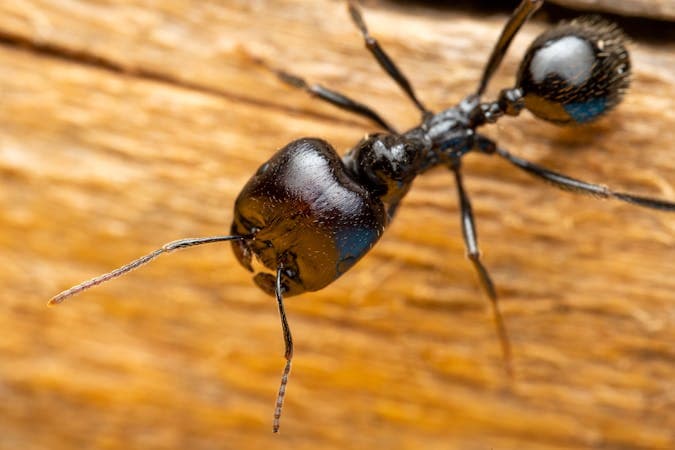
Carpenter Ants in Manhattan Apartments: Spring Invasion Guide
Carpenter ants in a Manhattan apartment might seem unlikely — these are large insects most people associate with forests and wooden cabins. But every spring, *Camponotus pennsylvanicus* and related species push into NYC's pre-war buildings, high-rises, and brownstones in search of nesting sites and food. If you've spotted large black or reddish-black ants in your kitchen or bathroom in March or April, you may be dealing with a spring carpenter ant invasion.
Why Spring Brings Carpenter Ants Indoors
Carpenter ants are not dormant in winter — they overwinter in existing nests, often within the walls or structural wood of buildings. As temperatures rise above 50°F in early spring, ant activity explodes. Workers that had been sluggish throughout winter resume foraging aggressively, and new satellite colonies may begin establishing.
In Manhattan, this typically means late March through May is peak carpenter ant sighting season. Residents often see large ants — typically ¼ to ½ inch long — emerging from wall voids, appearing near windowsills, or trailing along baseboards toward kitchens and bathrooms.
Do Carpenter Ants Actually Eat Wood?
Carpenter ants do not eat wood — they excavate it. Unlike termites, they chew through soft, often moisture-damaged wood to create smooth-walled galleries for nesting. This is an important distinction: carpenter ants are attracted to wood that is already compromised by moisture or decay. Finding carpenter ants in a building is often a signal that a moisture problem exists somewhere in the structure.
Why Manhattan's Pre-War Buildings Are Prime Targets
Manhattan's pre-war apartment buildings — common across the Upper West Side, Upper East Side, Harlem, Washington Heights, and Inwood — were constructed with old-growth lumber that, after 80 to 100 years, has often been affected by slow leaks, condensation, and general aging. These conditions create exactly what carpenter ants seek:
High-rise buildings with concrete construction are less vulnerable to structural nesting but can still host foraging colonies entering through window gaps, utility penetrations, or elevator shaft openings.
Signs of a Carpenter Ant Infestation in Your Apartment
Watch for these indicators:
In Multi-Unit Buildings, One Unit's Problem Is Everyone's Problem
Carpenter ants establish satellite colonies connected to a main nest. In a Manhattan apartment building, the main colony may be in a shared wall, basement, or roof structure, while satellite nests extend into individual units. Treating a single apartment without addressing the larger building context rarely solves the problem permanently.
Organic and Eco-Friendly Carpenter Ant Treatment
Effective carpenter ant control involves two strategies working together:
1. **Source identification:** Locating the main colony and satellite nests — often through moisture mapping and careful inspection of wall voids, basements, and roof areas
2. **Targeted treatment:** Applying low-impact, targeted materials into wall voids, expansion joints, and nesting sites without broad-scale indoor spraying
Organic Pest Control NYC uses family-considerate, eco-friendly products that are precisely applied to nesting sites rather than blanket-sprayed throughout living areas. Bait-based approaches can also be effective — workers carry the material back to the colony, addressing the source rather than just the individuals you see.
**Moisture remediation is essential.** Without fixing the underlying water issue, carpenter ants will return regardless of treatment. We work with homeowners and building managers to identify moisture sources as part of our treatment process.
FAQ: Carpenter Ants in NYC Apartments
**Q: How do I know if it's a carpenter ant or a regular house ant?**
A: Carpenter ants are significantly larger — ¼ to ½ inch — with a smooth, rounded thorax. Common house ants (pavement ants, odorous house ants) are much smaller, typically 1/16 to 1/8 inch.
**Q: Can carpenter ants damage my apartment's structure?**
A: In individual apartments, structural damage risk is lower than in single-family homes. However, if the main colony is within the building's structural wood or shared walls, long-term damage to the building is possible.
**Q: Should I tell my building manager?**
A: Yes — especially if you're in a pre-war or older building. Building-wide inspection is often necessary to find the main colony and prevent spread.
**Q: Are carpenter ants active year-round?**
A: They slow down in winter but don't truly hibernate. Spring is when activity surges and when they're most visible.
---
Spotting large ants in your Manhattan apartment this spring? Organic Pest Control NYC specializes in eco-friendly carpenter ant treatment for NYC's unique building stock. Call us at **(212) 580-9301** or Book Now to schedule an inspection — we'll locate the source and treat it right the first time.